AI Team Building · Operation Parallax

Team Building with AI
for Companies

The first AI team building activity where your team questions the suspects by chat and artificial intelligence answers back. Every interrogation is unique, no two games are alike, and only the team that knows how to ask will unmask the traitor.

Group size
From 10 people
Duration
1.5 to 2 hours
Venue
Indoor
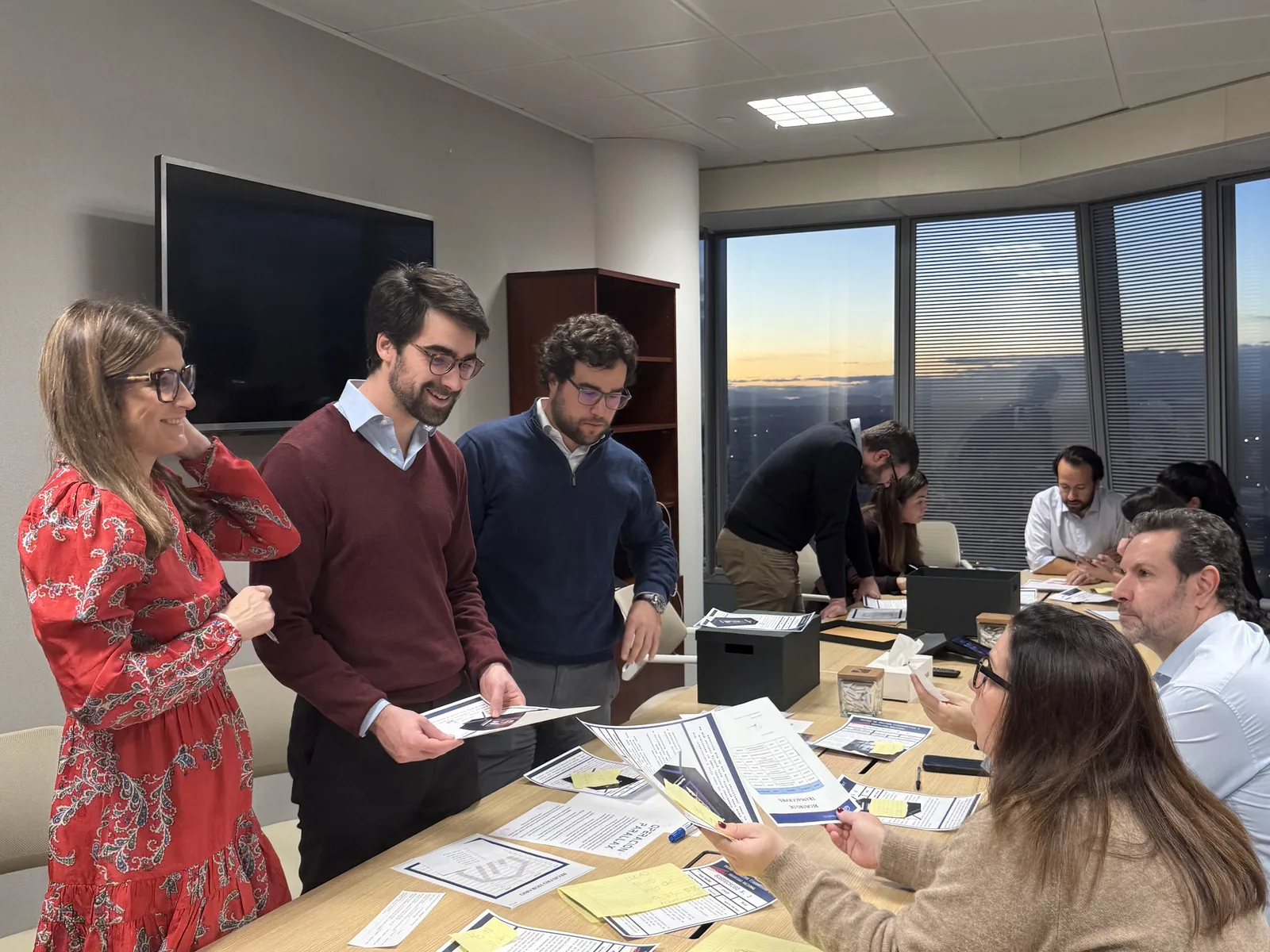
Corporate team interrogating the suspects in the AI team building Operation Parallax in Madrid
Operation Parallax · AI
Top rated in Madrid
AI interrogations

What team building with
artificial intelligence is

"You don't just read the suspect's file. You question him, he answers back, and it is up to you to catch him out on his alibi."

Operation Parallax is genuine team building with artificial intelligence: an escape room where AI is not decoration but the engine of the game. The same mystery box with puzzles, hidden clues and VR scenes, plus a layer no other AI team building activity offers. Instead of ruling suspects out by reading static cards, the team walks into an interrogation room and talks by chat with the suspects, who answer in real time using artificial intelligence.

Every suspect has an alibi, a version of events and contradictions of their own. Teams ask whatever they want, in whatever order they choose, and the characters answer on the spot. That is why every interrogation is unique and no two games are ever the same.

The challenge is not reading, it is questioning well: spotting the inconsistency between two statements, pressing on the weak point and building the theory of the case before the clock runs out. Communication, strategy and critical thinking are the only way to win.

Operation Parallax comes in two versions. This is the artificial intelligence version, where the suspects answer by chat. If you prefer the classic format, solved with puzzles, physical clues and suspect cards you rule out one by one, that is the portable escape room for companies.

Want to understand how artificial intelligence fits into a team day? We explain it in depth in our guide to artificial intelligence in team building (in Spanish).

Question the suspects.
They answer with AI

Each team opens its interrogation room, picks a suspect and types their questions. There are no menus or scripted dialogue: artificial intelligence generates every answer on the spot, based on what each team decides to ask.

Every interrogation is unique
Answers are generated on the fly from your questions. No two teams ever have the same conversation.
The characters adapt
Every suspect defends their alibi and reacts to pressure. Press on the right point and they slip up.
Contradictions to catch
Statements that do not always add up. Cross-checking versions and spotting the lie is how the case gets solved.
Genuine replay value
You can question any suspect as many times as you need. Every round opens up a new angle.
Suspect 03
One of the suspects in the case
Under questioning
Where were you when the alarm went off?
In my office, going through reports. Alone, as I usually am at that hour. I rarely have anyone around when I work.
Nobody can confirm you were there. How do you explain that?
Nobody seeing me does not mean I was not there. I am not in the habit of announcing where I am at all times.
Your credentials show up on an access you deny making.
AI is answering…

Illustrative example. The real conversation is built by each team with its own questions.

Real AI team building,
not AI as a prop

Almost everything sold as "team building with artificial intelligence" uses AI as set dressing: a generated video, a themed talk or a chatbot with canned replies. Here artificial intelligence is the engine of the game, not an ornament.

AI as a prop
  • Canned replies or preset menus
  • AI shows up once, as a gimmick
  • The same game for every team
  • The technology is decorative
Operation Parallax
  • Free conversation: the team types whatever it wants
  • AI generates every answer in real time and in character
  • No game repeats: each team sets its own path
  • AI is the core of the challenge, not an add-on

Every team gets its own
interrogation room

The questioning is digital, the investigation is physical. Each team enters its room with a simple QR code and still has all the usual material on the table to crack the case.

QR access

Each team scans a QR code and goes straight into its own interrogation room. No apps, no installs: within seconds they are questioning suspects. Every room is independent, so teams compete in parallel.

Optional extra

One tablet per team

As an extra we provide one tablet per team, for anyone who would rather not use staff phones. Your call.

The physical material stays

The box does not disappear. Case files, evidence, puzzles and props stay on the table. The interrogation is the new part, but the team still leans on everything physical to cross-check data and build its theory.

You can go back and question any suspect as often as you need. Every statement adds clues, but also noise. Knowing who to press is the key to solving the challenge.

The mission

Operation Parallax

A group of hackers has broken into the systems of a tech company and stolen critical artificial intelligence research. They are planning a global cyberattack. And the problem does not end there: someone inside the company is working with them.

Your team goes in as the investigation unit. Suspects to question, an interrogation room and the clock running. The only way through is to ask better questions than anyone else. Can you unmask the culprit before time runs out?

01
Find the secret coordinates that reveal the location of the hackers' base of operations.
02
Unmask the traitor by questioning the suspects and cross-checking their statements until the contradiction appears.

Everything included in
the AI experience

01

AI interrogation room

The heart of the experience. Each team enters its own room with a QR code and questions the suspects by chat, and they answer in real time. Every chat is unique.

02

Riddles and 3D puzzles

Physical brain-teasers, three-dimensional puzzles and riddles with numeric and alphabetic solutions. Part of the challenge is working out how one answer feeds into the next.

03

Hidden clues

Not everything is in plain sight. Some pieces of evidence need specific tools to reveal what they hold. Part of the challenge is realising what is hidden and knowing where to look.

04

360º VR scenes

Mobile virtual reality scenes to explore the locations in the case. Participants move through the spaces and find clues that exist nowhere else.

05

Case files and evidence

Suspect files, evidence and investigation notes, all physical. The team logs alibis and contradictions on the table and builds the theory of the case piece by piece, until it can name the culprit.

06

Our team running the session

A Froggy facilitator runs the session from start to finish: introduces the case, keeps the pace, answers questions and closes with the debrief. Our own team, no subcontractors.

How AI team building works

The case opens, the clock starts, and the team that unmasks the traitor and finds the coordinates first wins.

01
Briefing
We introduce Operation Parallax and the objectives. Teams are formed, each gets its box and its access to the interrogation room. The clock starts.
02
Interrogations
The team talks by chat with the suspects. They ask, press, double back and cross-check versions. The AI answers in character as they go.
03
The final theory
With the statements and the physical evidence lined up, the team names the culprit, locates the coordinates and lays out its theory of the modus operandi.
04
The verdict
Results are revealed. The team that completes both objectives in the shortest time wins, and the debrief closes the experience.

Why AI changes what
the team experiences

There is a world of difference between reading a suspect's file and having to prise the truth out of them. In the classic version the information is written down and the challenge is to interpret it. In the AI version the information has to be earned: the team decides what to ask, how to phrase it and when to press. That sense of facing someone who might be lying to you changes how invested people get.

Because answers are generated on the spot, no two games are alike. A team that starts with timeline alibis will live a different case from one that digs into the relationships between departments. That also makes the activity ideal for groups that come back: the culprit may be the same, but the route never is.

The format forces real coordination. Someone leads the questioning, someone logs the contradictions, someone cross-checks against the physical evidence in the box. Roles emerge on their own and the usual company hierarchy stops mattering. What matters is whether the team can question well together.

And the closing debrief, when each team explains who it accused and on what evidence, sparks a conversation no traditional workshop manages to provoke. Seeing how two teams reached different conclusions questioning the same people says a great deal about how each group thinks and decides.

Skills the team develops
in AI team building

Interrogating under pressure, cross-checking contradictory information and deciding as a team activates exactly the skills that matter most at work.

Communication

Asking the right question, listening to the whole answer and sharing what each person finds out. Without fluid communication, the contradictions go unnoticed.

Critical thinking

Reading the answers is not enough: you have to doubt them. Comparing statements, spotting the inconsistency and separating the useful fact from the noise is the heart of the challenge.

Organisation

The suspects, the physical evidence and a clock that keeps running. The team that splits the work and decides who to question first moves far faster than the one that improvises.

Decision-making

With incomplete information and limited time, the team has to decide who to believe and who to accuse. Waiting for absolute certainty is not an option while the clock runs.

Creativity

The cleverest questions are the ones that get to the truth. Thinking laterally about how to approach each suspect is what breaks the deadlocks.

Cooperation

No one solves the case alone. The truth appears when you put together the pieces each person has pulled out of a different interrogation.

What kind of corporate events
it is designed for

✓
Tech, data, consulting and legal companies that enjoy an intellectual challenge and want an activity that genuinely uses AI
✓
Teams that have already done a classic escape box or a murder-mystery game and want something new that surprises them
✓
Conferences and kick-offs that need a different afternoon activity: indoor and scalable to large groups
✓
Departments that want to work on communication, critical thinking and team decision-making in a format people remember

Questioning the suspects and having them answer like real people is what hooked the whole team. Nobody expected to be able to ask whatever they wanted. We were still turning the case over days later.

Marta R. · People Director, technology company

Frequently asked questions about
AI team building

Each team gets its own digital interrogation room by scanning a QR code. The team picks a suspect and questions them by chat, typing their own questions. The suspect answers in real time, powered by artificial intelligence, holding on to their alibi and their version of events. There are no closed answers and no menus of options: the team asks whatever it wants and the conversation is built on the spot.

Yes. Because the answers are generated by AI from each team’s specific questions, no two interrogations are alike. The culprit and the solution are fixed, but the route to get there depends on what each team asks, in what order and with what strategy. You can question any suspect as many times as you need, and every round adds new nuance.

They are the same case, Operation Parallax, in two different formats. The portable escape room is solved with physical puzzles, hidden clues and suspect cards you rule out one by one. This version adds the artificial intelligence layer: instead of reading a static file, the team talks to the suspects, spots the contradictions between their statements and uses that to unmask the traitor. The physical box and the VR scenarios are in both.

From 10 people up to large groups. Each team works with its own device and its own access to the interrogation room, so several teams can play in parallel and compete to solve the case first. It is one of the most scalable formats in our catalogue.

No. Each suspect is designed to answer only within their role and within the world of the case. The AI gives the team freedom to ask anything, but the characters stay in character, protect their alibi and never leave the story. The result is a free, believable conversation that is still under control.

Yes. We can adapt parts of the plot, the character profiles or add references to your company culture so the experience feels closer and more immersive. That is one of the advantages of working with our own in-house team and no middlemen.

Each team reaches its interrogation room by scanning a QR code, so it can be played from any team member’s phone with nothing to install. If you would rather not use staff phones, we offer one tablet per team as an extra and we bring them. The rest of the experience runs on the physical material in the box: police files, evidence and puzzles.

The price depends on the size of the group and on whether the event is set up at your own venue or a rented one. For groups of fewer than 20 people we work with a fixed price per event, because the setup, the material and the crew are the same as for a large group. Ask us for a proposal: we reply in under 24 hours.

Shall we run this
event for your company?

We reply in under 24 hours. No small print.